
When I first started researching laser equipment for our shop, I assumed the brand name mattered most. If you'd asked me in 2022 which machine to buy, I'd have said "Bystronic" without hesitation—the safe answer, the brand everyone respects. Three years and a couple of procurement mistakes later, I've changed my mind.
Not about Bystronic, though. Their machines are genuinely excellent. But "the best machine" and "the right machine for your shop" are two completely different questions—and conflating them is how companies waste six figures.
Here's my context: I'm the purchasing coordinator for a 38-person metal fabrication company. I manage equipment and supply orders—roughly $2.5M a year across 30 vendors. I report to both operations and finance. That puts me between the production manager who wants maximum capability and the CFO who questions every capital request, and that tension has taught me more than any spec sheet ever did.
The honest answer: there's no universal "best" laser machine. The right choice depends on what you're processing, the volume you're running, and who's going to operate it. In my experience, every laser purchase request falls into one of three scenarios. It might be a $3,500 desktop fiber laser, a $300,000+ Bystronic fiber laser cutting machine, or a Bystronic press brake—and here's how to know which one you're actually shopping for.
Start Here: Three Scenarios, Different Machines
Before I look at brands or prices, I classify the request with three questions:
- What's the dominant work—metal cutting or marking/engraving? Cutting full sheets is a completely different requirement from marking serial numbers.
- What's the volume? Sheets per day or parts per week?
- Who's using it? A trained fabricator, or the whole shop floor?
Your answers point to one of three paths. Here's what I'd buy in each one.
Scenario A: Marking, Engraving, Low-Volume Mixed Work
If you need to mark serial numbers, engrave logo plates, or cut thin stock in small batches—without processing full metal sheets daily—you do not need a six-figure industrial machine. You need a desktop laser. And for most small shops, a 20W fiber unit will handle 80% of what actually shows up.
The ComMarker B4 20W fiber laser price runs around $3,000–$4,000 depending on the bundle, based on public listings I checked in January 2025. Maybe $4,200 with the rotary attachment included, but I'd have to verify current listings. For stainless steel, aluminum, even hardened tool steel, this thing marks cleanly and reliably. For part traceability and branding, that's usually enough.
Now the Halo CO2 laser is the other popular entry in this tier—and this is where I see the most expensive mistake. CO2 lasers are excellent for wood, acrylic, leather, and glass. They cannot directly mark bare metal. I've talked to at least three shops—and read countless forum threads—where someone bought a CO2 laser, often the Halo, then complained that "machine laser engraving" on their metal parts didn't work. The machine is fine. It's the wrong laser type for the job.
Rule of thumb: organic materials → CO2, and the Halo is a solid option. Bare metal → fiber, and the ComMarker B4 is a reasonable starting point. Need both? Buy both if the budget allows. If it doesn't, buy the one that supports your revenue-generating work and let the other wait.
Here's the counterintuitive part that gets me pushback from production people: for most small shops, a desktop fiber laser is the correct first laser—not the iconic industrial brand. I've seen a 14-person shop burn $80,000 on a mid-tier industrial machine that ran two hours a day because they never honestly assessed their order volume. A $3,500 desktop unit would've covered 90% of that work. At this scale, the desktop is not a compromise.
Scenario B: Cutting Sheet Metal Every Day
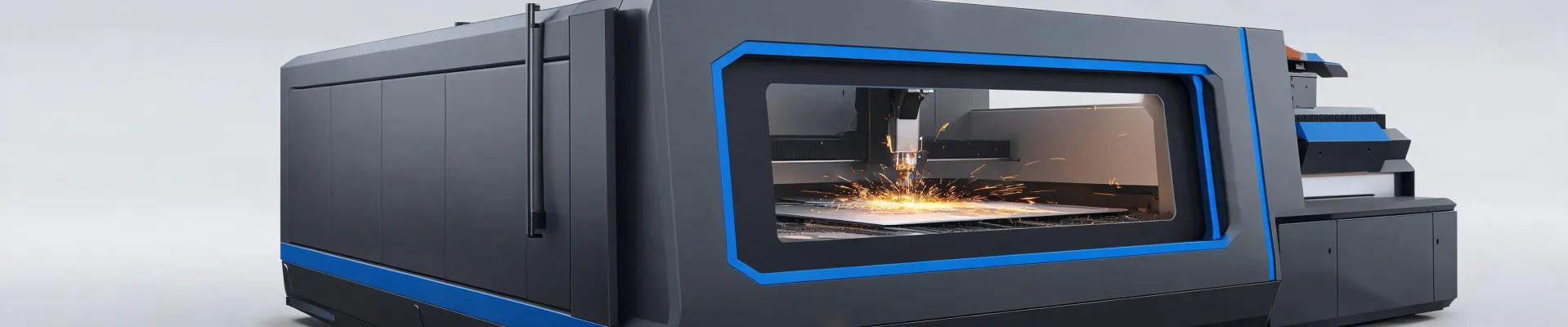
Once you're quoting flat sheet parts and cutting multiple sheets daily, the requirement changes completely. This is where Bystronic fiber laser cutting machines come in—and now they're not competing with the ComMarker anymore.
A Bystronic fiber laser cutting machine, even a 4kW entry-class model, handles full-size sheets, cuts mild steel, stainless, and aluminum at production speeds, and holds tolerances around ±0.05mm. A desktop unit physically cannot do that. If you're bidding production sheet metal jobs, a desktop laser won't get you there.
My team faced this decision in 2024. The upside was clear: in-house cutting capability, control over lead times, margin on every part. The risk was the worst case—$300,000+ of capital equipment sitting idle if the work didn't materialize. We had about two weeks to decide before the Q3 order cycle, so I couldn't run the full 60-day utilization study I would've preferred. I based the projection on our quote log and the invoices we'd paid to outside laser cutting vendors over the previous twelve months. Those outsourced invoices alone nearly justified the machine payment. That shifted the math.
And this is the second counterintuitive point: at production volume, a Bystronic is cheaper per part than a desktop laser. I know it sounds absurd to compare a $300,000 machine against a $3,500 one. But the desktop unit becomes a bottleneck at volume—waste goes up, labor hours balloon, throughput stalls. In 2024, I watched a job shop run its small fiber unit for marking and thin cutting, then outsource 60% of its flat cutting because of backlog. The outsourcing ate their margin. Spread across enough work orders, the industrial machine is genuinely more economical on a cost-per-part basis.
What changed my thinking over time? Honestly, the industry has shifted. Back in 2020, "outsource everything and keep capex low" was a defensible strategy. In 2025, external laser cutting lead times are unpredictable, per-sheet pricing has climbed, and shops that own their primary cutting capability control their schedules. What was best practice five years ago isn't a law of nature—the execution has transformed, even though the fundamentals haven't.
Scenario C: When Flat Parts Need Bending
Here's a number I keep in mind: roughly two-thirds of the flat cut parts we produce need bending or forming afterward. If you're at that point, you're not buying a cutting machine. You're assembling a production cell—and the Bystronic press brake price becomes the number you need to understand.
The Bystronic press brake price depends heavily on tonnage and automation level. A standalone 100-ton class Xpert press brake typically lands between $180,000 and $250,000, based on public listings I reviewed in February 2025. Add automation—a ByTrans or ByBend cell—and you're looking at $300,000 to $500,000 or more. To be fair, that buys more than bending force: it buys the tooling library, calibration systems, and software that make short-run setups practical.
The trap I've seen: companies buy the full automation suite before the order volume justifies it. If bending is occasional, use a press brake service and reinvest the difference. Start evaluating the purchase when your bending vendor invoices consistently match a machine payment. That's the crossover point.
How to Tell Which Scenario You're In
Here's the three-question self-assessment I walk every stakeholder through:
- What dominates your laser work? If marking and engraving is 70% or more of your jobs, you're in Scenario A. Full-sheet cutting is Scenario B or C territory.
- How many sheets per day? Under 5 on average—a desktop laser can often handle it. Over 10—you need an industrial fiber laser. In between, run a utilization study before committing.
- Do parts need bending after cutting? Flat cut only—stay in Scenario B. If you're forming parts or paying bending vendors monthly, build the Scenario C financial case now.
What I've learned after five years of managing these purchases: the wrong buy is rarely about the machine itself. It's about buying for the business you hope to become instead of the one you are today. You can upgrade later. You can't easily undo a bad capital investment.
This approach worked for our shop, but our situation is specific—38 employees, mixed fabrication, a CFO who questions everything. If you're a seasonal business with unpredictable demand, the calculus might be different. I'd still start with those three questions.

Jane Smith
I’m Jane Smith, a senior content writer with over 15 years of experience in the packaging and printing industry. I specialize in writing about the latest trends, technologies, and best practices in packaging design, sustainability, and printing techniques. My goal is to help businesses understand complex printing processes and design solutions that enhance both product packaging and brand visibility.