
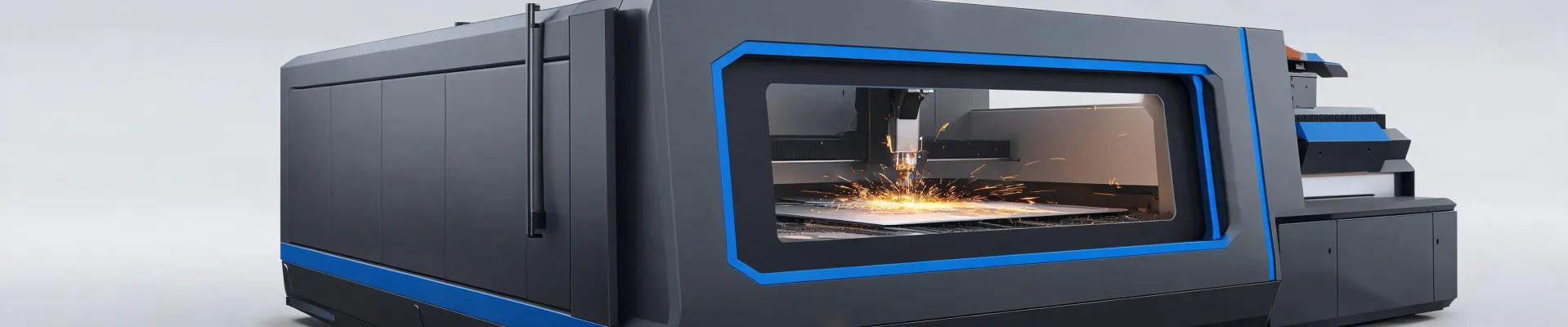
At 4:37 on a Thursday, I got a call that should have been routine. The voice on the other end was a job-shop owner in the Midwest who runs a Bystronic BySmart Fiber 4kW fiber laser. He was 36 hours from a deadline: 2,000 steel brackets for an agriculture equipment manufacturer. His words: 'It started leaving burns on every edge.' He wanted a service tech there that night.
I have spent 12 years coordinating emergency service for industrial laser users. In that time I have handled more than 300 rush calls. I can tell you without hesitation: he was asking the wrong question. The question wasn't 'how fast can you get a tech here?' The question was 'why is the machine burning parts now, after months of smooth running?'
The surface problem: everyone assumes the source is dying
When a laser cutter starts producing burnt edges, the first instinct is to blame the source. That is human. You cannot see the beam, so you imagine something inside the resonator or oscillator is fading. But when I look back at our service logs from 200+ rush jobs, the source is rarely the actual failure.
The real chain usually starts earlier and much smaller. A slightly worn nozzle. A fogged protective window. A focus lens with one tiny splash of spatter. Day by day, the cut gets rougher. Edge quality degrades. Then one morning, dross appears and the edge looks scorched. If the operator panics and turns the power up, it gets worse. Now you have an emergency.
Fiber laser how it works: the emergency primer
Does that heading sound too basic? Maybe. But in an emergency, the difference between a $50 nozzle and a $30,000 source replacement comes down to knowing how a fiber laser actually works.
A fiber laser uses diode pumps to send light into a fiber doped with rare-earth elements, usually ytterbium. The excited ytterbium emits light at about 1,070 nanometers. That light travels through a fiber delivery cable to the cutting head, where a lens focuses it onto the material. Assist gas blows the molten metal out of the kerf. The BySmart Fiber system uses this same principle.
A CO2 laser is different. It generates a beam at around 10.6 micrometers in a gas-filled resonator and directs it with mirrors. The two technologies have different failure modes. When a CO2 machine starts leaving burned edges, I usually think about contaminated optics, impure assist gas, or a small alignment error. When a 4kW fiber laser starts leaving burns, I think about the nozzle, focus position, protective window, or gas pressure. In neither case is the first answer usually 'replace the resonator.'
The phrase 'CO2 laser burns' shows up in service emails more often than you'd think. It feeds the confusion. People see a scorched edge and assume the laser itself is burning the material. But laser cutting is melting, not burning. If you see burn discoloration at the edge, that is a symptom. The machine is not on fire; the beam path is not transferring energy the way it should.
The empty spare-parts drawer is the hidden root cause
Here is a pattern I see every quarter. Shops that keep a small stock of critical consumables need emergency parts far less often. Shops that order Bystronic laser parts only after something fails are the ones calling us on weekends. I am not talking about exotic components. I am talking about cutting nozzles, protective windows, focus lenses, and ceramic rings.
If you run a Bystronic BySmart Fiber 4kW fiber laser, your minimum set is simple: cutting nozzles in the sizes you use most, two protective windows, one spare focus lens, and ceramic rings. If you run a CO2 machine, add spare optics and alignment mirrors. The cost of that kit is a fraction of one emergency service call. It turns a two-day outage into a 20-minute repair.
But there is another layer. Smaller shops often cannot get a large supplier to answer the phone quickly. A two-person shop with one laser is not a million-dollar account, so its request sits at the bottom of a queue. That is a mistake. I have seen $150 parts orders treated as a nuisance. Small does not mean unimportant; it means unforgiving. A machine down in a small shop is the same risk as a production line down in a factory.
Small does not mean unimportant. It means unforgiving.
What an emergency really costs
Let's put numbers on it. If your burdened shop rate is $150 per hour, 16 hours of downtime is about $2,400 in lost production. That is the number people quote first, but it is not the real number. Add overtime labor, overnight freight, premium service time, and any late-penalty clause in your customer contract. The same tiny failure can easily pass $10,000.
In March 2024, a client called 36 hours before a deadline with a cracked focus lens on their 4kW fiber laser. Normal ground delivery was four days; we paid $380 for overnight air freight and got it there in time. Total impact was around $6,000 with overtime included. That client was lucky.
A different client tried to save money by ordering an aftermarket lens from an online marketplace. It arrived in time but wasn't made to the right flatness tolerance. The result was poor focus for three more days, $18,000 in rework, and a lost delivery deadline. Cheap parts often cost the most.
In my first few years, I used to think these failures were random. It took me about 60 emergency visits and an entire year of data to see the pattern. The pattern was not 'the laser broke.' It was a series of rational small decisions made in calm moments: skipping maintenance, buying a cut-rate nozzle, ignoring a small stain on the window. The emergency starts inside those quiet choices.
I also get calls that start as a Google search for 'CO2 laser Odessa' or 'bystronic service near me.' By the time they reach a human, the shop owner has already lost a day, maybe two, trying to diagnose and source the part alone. That is proof that knowing the beam path and stocking a few consumables saves more time than any emergency hotline.
The fix is shorter than the problem
The answer is not a 24/7 maintenance contract. It is basic literacy and basic inventory.
- Take 20 minutes to trace the beam path on your machine. Know where the protective window is, what the focus lens does, and why gas pressure affects edge quality.
- Keep the most common consumables in stock. Add a simple inspection checklist for optics; replace damaged parts immediately.
- Use genuine Bystronic laser parts for anything in the beam path. Aftermarket parts are a gamble. I have seen a cheap nozzle produce the exact edge burns that get blamed on the laser source.
- Choose support partners that treat your small order like a real customer. If a vendor only calls back after $1,000 in parts, they will not help you in a real emergency.
The next time your Bystronic BySmart Fiber 4kW fiber laser leaves burnt edges, stop before calling for help. Ask yourself: what did I ignore three weeks ago? That is where the emergency really started.
Fiber laser how it works, why it fails, and how to recover from it is not a physics exam. It is the difference between buying a new lens and buying a new source. Learn that one step, keep a small drawer of good parts, and the 'emergency' becomes a maintenance break.

Jane Smith
I’m Jane Smith, a senior content writer with over 15 years of experience in the packaging and printing industry. I specialize in writing about the latest trends, technologies, and best practices in packaging design, sustainability, and printing techniques. My goal is to help businesses understand complex printing processes and design solutions that enhance both product packaging and brand visibility.